March 09, 2011

Paavo live at Jazzfest Berlin 2010


Sofia Jernberg, voice
Cecilia Persson, piano
Per ‘Texas’ Johansson, reeds
Alberto Pinton, reeds
Marcelo Gabard Pazos, reeds
Emil Strandberg, trumpet
Clas Lassbo, bass
Gustav Nahlin, drums

recorded live at Haus der Berliner Festspiele, Side Stage, November 4, 2010

1. Canter
2. Carved out
3. Passage
4. Sandpaper
5. Krock
6. Climb Above The Trees
7. ambush

Vocal jazz “made in Sweden” has long since become an international trademark. Singer Sofia Jernberg single-mindedly pursues her own ways between jazz-poetry and the abstraction of contemporary classical music, employing her voice in a mostly instrumental manner.
Jointly founded in 2004 with pianist Cecilia Persson, the music of this duo is constantly altered and advanced. No musical state is designed to last for long, yet rather stark disruptions are shunned in favour of soft transitions or minimalist displacements. On the border between precise notation and free improvisation, the band imperceptibly oscillates from warm to cold, from close to distanced, from static to dynamic. The music is absolutely transparent – one can virtually see through it in all its refractions. Besides the enchantment of Sofia Jernberg’s crystal-clear voice it is this internal friction that makes this multifariously iridescent happening so fascinating and alluring.


February 24, 2011

zeitkratzer vs. Terje Rypdal & Palle Mikkelborg: ‘Beyond’ at SWR NEWJazz Meeting, Baden-Baden 2010


Reinhold Friedl musical director, piano
Burkhard Schlothauer violin
Anton Lukoszevieze cello
Uli Phillipp bass
Maurice de Martin percussion
Marc Weiser electronics
Frank Gratkowski clarinet, saxophone
Hild Sofie Tafjord French horn
Hilary Jeffery trombone
Terje Rypdal guitar
Palle Mikkelborg leader, trumpet

recorded live at  SWR NEWJazz Meeting, Baden-Baden, November 4, 2010

This group’s name says it all. Berlin-based zeitkratzer (“time-scraper”) ensemble, grouped around composer, pianist and musical director Reinhold Friedl chips away at the norms of time. The ensemble’s top-class line-up interprets the notion of “contemporary music” in its very own way, it “shakes off the chains of notation” by first and foremost emphasising the aspect of “contemporariness”.
In joint projects with Lou Reed, Jim O’Rourke or Merzbow, the group’s underlying concept of a European soloists’ ensemble displayed surprising intersections of different contemporary conceptions of organising sound. Their ensemble thereby benefits from the diverse experiences its members have with improvisation, electronics, Minimalist music, Rock, Pop, Noise and folklore, the voyage always heading further into the past as well as into the future.
With Norwegian guitarist Terje Rypdal and Danish trumpet player Palle Mikkelborg zeitkratzer has invited two heavyweights of Nordic jazz who in their intensive application of different timbres on their part for five decades have been blurring the outlines of musical categories.
zeitkratzer´s latest CD is called "zeitkratzer WHITEHOUSE"


February 17, 2011

hr-Bigband feat. Joachim Kühn Trio: Out of the Desert live at Jazzfest Berlin 2010


Ed Partyka conductor
Frank Wellert, Martin Auer, Thomas Vogel, Axel Schlosser trumpet
Günter Bollmann, Peter Feil, Christian Jaksjø trombone
Manfred Honetschläger bass trombone
Heinz-Dieter Sauerborn, Oliver Leicht, Tony Lakatos, Julian Argüelles reeds
Peter Reiter Fender Rhodes
Martin Scales guitar
Thomas Heidepriem bass
Jean Paul Höchstädter drums

Joachim Kühn piano
Majid Bekkas vocals, guembri, oud, kalimba
Ramon Lopez drums, percussion
recorded live at Haus der Berliner Festspiele, Main Stage, November 6, 2010

1. Night in the desert
2. Klangzeit
3. Der Wanderer
4. Fresh Air
5. Lichtquelle   

The great avant-garde pianist Joachim Kühn celebrated his 64th birthday in March, 2008, and spent it in the desert doing what he does best – making music. He played in the middle of the Sahara with Moroccan Berbers, the desert musicians of the “Source Bleue des Meski”, a small oasis near the Algerian border. This is documented on his album Out of the Desert. Kühn, his trio members and the North African musicians share the Maghreb’s heat, its richness of colours and its variety of forms. Departing from this experience and this fundus of material, Kühn wrote a special programme for the hr-Bigband. The 2009 premiere at Deutsches Jazzfestival Frankfurt was an overwhelming success and Frankfurter Allgemeine magazine even praised the stirring performance a “musical miracle”.
Joachim Kühn, first and foremost world-renowned as an imaginative virtuoso, in this project also impressively bears witness to his capabilities as a composer and big band-arranger. His input is the perfect starting point for the vibrant attacks of one of Germany’s longest-serving jazz orchestras which happily contributes all of its wealth of experience reaching from swing to avant-garde.
The new album by Joachim Kühn "Chalabas" will be released on ACT on February 25.

February 16, 2011

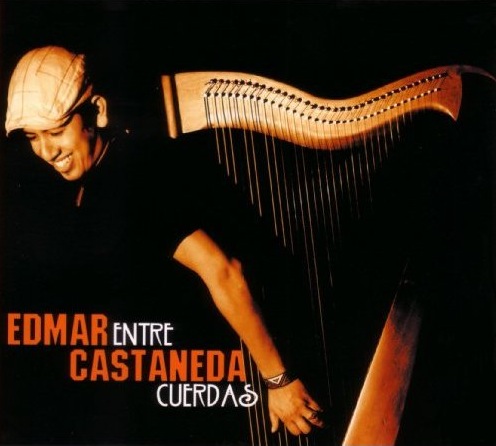
Edmar Castaneda - Joe Locke Duo live at JazzBaltica 2010


Edmar Castaneda - Colombian Harp
Joe Locke - Vibraphone
Andrea Tierra - Vocals

recorded live at Konzertscheune Salzau, July 4, 2010

1. Entre Cuerdas
2. Sword of Whispers
3. Ocaso de Mar
4. Jesus de Nazareth
5. Love is a Planchette
6. Poema de Cuerdas
7. Polka Dots and Moonbeams
8. Colibri

After joining Colombian born New York harpist Edmar Castaneda and his trio for various international concert performances over the last 12 months, Joe was honoured to be asked to appear on Edmar's new recording "Entre Cuerdas" as a guest artist. The album, also featuring Marshall Gilkes (trombone), Dave Silliman (drums and percussion), and further guests John Scofield (guitar), Andrea Tierra (vocals) and Samuel Torres (cajon) is now on general release at ArtistShare. 

Thomas Quasthoff live at A-Trane Berlin 2010


Thomas Quasthoff - vocals
Bruno Müller - guitars
Frank Chastenier - keyboards (Grand Piano • Fender Rhodes Stage Piano • Hammond RT-3 with Leslie 760 • Hohner Clavinet D6)
Dieter Ilg -bass
Wolfgang Haffner - drums

1. Lost Mind (Percy Mayfield)
2. Mercy, Mercy Me (Marvin Gaye)
3. Tell It Like It Is (George Davis, Lee Diamond)
4. Rainy Night In Georgia (Randy Crawford)
5. Seventh Son (Willie Dixon)
6. Imagine (John Lennon)
7. Kissing My Love (Bill Withers)
8. Rider In The Rain (Randy Newman)
9. The Whistleman (Michael Quasthoff)
10. Ain´t No Sunshine (Bill Withers)
11. Have a Talk With God (Stevie Wonder)
12. Hallelujah, I Love Her So (Ray Charles)
13. Short People (Randy Newman)
14. Have a Little Faith In Me (John Hiatt)

"Why do we make music?" A rhetorical question that Thomas Quasthoff poses unexpectedly in the midst of a longish discussion of Schubert, blinkers, soul and the pros and cons of popular repertoire and classical traditions. "Of course, it's possible to make music with the noble purpose of giving people something intellectual. In the end, though, music has also got to move people. Right here and now. Head and heart. To do that you have to toss out all those pigeonholes." He takes a deep breath and flashes a broad smile. "And that's just where I come in, as the title says: Tell It Like It Is. Nothing more and nothing less." The "man with the most beautiful voice in the world", as the German magazine Stern described him, knows exactly what he's doing. And what he wants. Power of interpretation and unerring sense of taste go hand in hand in performing American songs as well as Italian arias. The extent to which the bass-baritone does justice to his objective of genuinely moving people with his voice is clear from the audience reaction. The material that makes up this album was, unconventionally, "rehearsed live" before the studio sessions. With each of their appearances in February 2010, the singer and his hand-picked instrumentalists worked their way deeper into the pieces. In addition, the applause and "unbounded cheering" (Die Welt) had the effect of singling out certain numbers. And so this album represents "favorite songs" in two senses.
"We grow up with music", Quasthoff replies when asked about the repertoire in this recording. "And for me the transitions were, let's say, very fluid." He then talks about his brother Michael, two years his senior, who had a decisive influence on his musical tastes, from old-time jazz to the avant-garde, "from Bix Beiderbecke to Louis Armstrong, Oscar Peterson and Cannonball Adderley, Dizzy Gillespie, Miles Davis and John Coltrane, and of course Don Cherry, Ornette Coleman and Cecil Taylor, as well as Peter Brötzmann and Alexander von Schlippenbach." Then there were the pop songs that filtered through from the radio, the classical repertoire associated with the early recognition of his talent, and, also from his brother, lots of soul, funk and country songs. "The range really was very, very broad," he emphasizes. "It was always important for me to have a wide horizon. I've always considered it dangerous to be one-sided. If you just put your feelers out a bit, it can be tremendously exciting." 

February 14, 2011

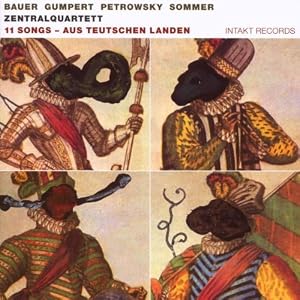
Zentralquartett live at XXX. Eldenaer Jazz Evenings 2010


Conrad Bauer (tb)
Ulrich Gumpert (p)
Ernst- Ludwig Petrowsky (sax, fl, cl)
Günter Sommer (dr)
recorded live at Klosterruine Eldena, July 2, 2010

1. Der Alte Thüringer (Ulrich Gumpert)
2. Es fiel ein Reif (in der Frühlingsnacht) (trad.)
3. Synopsis (Ulrich Gumpert)
4. Kiekbusch (trad.)
5. Careless Love (W.C. Handy)
6. Kommt Ihr G'spielen (Melchior Frank)
7. Es war ein König in Thule (Carl Friedrich Zelter)

Both the present and past live within Zentralquartett’s music. With their instruments, four musical personalities speak for themselves, having helped both fashion developments and put them into motion. Formed in 1973, they were originally called Synopsis. By the end of the seventies they had already made their mark on the international improvisation scene and earned a solid, recognized position in the GDR jazz scene. Then all four went their separate ways, none of them losing sight of one another however. A GDR Jazz Weekend in Paris in May 1984, organized by Conny Bauer, lead to the production of the LP Günter Sommer et Trois Vieux Amis: Ascenseur Pour Le 28 and the formation of a new quartet, the Zentralquartett.
The music is distinguished by a longstanding experience, both together and as soloists, of perfect assurance in improvised interaction, and is still ripe for musical surprises. It’s impressive how they create fantastic soundscapes time and again, steeped in wit and irony and performed with refreshing joy.
Their latest record 11 SONGS – AUS TEUTSCHEN LANDEN was released on intact in 2005.

February 13, 2011

Donny McCaslin Quartet live at Jazzclub Unterfahrt, Munich, 2010


Donny McCaslin - Tenor Saxophone
Uri Caine - Piano
Scott Colley - Bass
Antonio Sanchez - Drums
Unterfahrt München, November 14, 2010

1. M (Donny McCaslin)
2. Fat Cat (Donny McCaslin)
3. Memphis Redux (Donny McCaslin)

Following the sparse tenor trio album Recommended Tools, Perpetual Motion (released on Greenleaf Music) is a 180° turn for McCaslin. Never sounding more confident, McCaslin delves into angular post-bop, blistering polyphonic funk, backbeat-driven R&B, and delicate, ethereal balladry, all without compromising his distinct compositional voice.
Electronic elements are well-represented here: Adam Benjamin (Kneebody, Dave Douglas’ Keystone) conjures the Rings of Saturn with his highly modulated Fender Rhodes, bassist Tim Lefebvre punches sub-octave squarewave fuzz, and producer David Binney contributes his own synth sonics occasionally. All of this on a bed of deep drum grooves—that duty split between the masterful Antonio Sanchez and Mark Guiliana. Guest musician Uri Caine makes appearances as well, contributing his unique Fender Rhodes and piano playing to the tracks including the emphatic record closer.

February 12, 2011

Vijay Iyer Piano Solo live in Bonn 2010


Vijay Iyer, Piano
recorded live at Beethovenhaus Bonn, December 9, 2010

1.  One For Blount (Vijay Iyer)
2.  Autoscopy (Vijay Iyer)
3.  Human Nature/Black And Tan Fantasy (J. Bettis, S. Porcaro/ Duke Ellington, Bubber Miley)
4. Patterns (Vijay Iyer)
5. Imagine (John Lennon)

Vijay Iyer is the face of modern jazz. Hardly any other musician of this genre has been more acclaimed in the media recently, or received more important prizes, than the 38-year-old.
The most surprising thing about this unrivalled success story is that Iyer didn’t make any compromises along the way. The New York pianist and composer concentrates fully on his own musical value system, and any rapprochement to pop or world music appears utterly on his own specific terms. The music of this autodidact pianist-composer has an unrivalled complexity and distinctiveness about it. It baffles, captivates and entices with its highly rigorous yet also seemingly effortless incorporation of very different influences into its sound world, This achievement also reveals a man of great musical wisdom, His academic background does not yield overly scholastic-sounding music; rather, his work displays great breadth, depth, and feeling.

This is impressively revealed anew in his second ACT album, simply called “Solo”, with which Iyer now enters the supreme discipline of jazz piano. It is his first solo album and, fittingly, he dedicates himself to serious reflection. After contemplating temporal and cultural contexts with “Historicity”, with “Solo” he now focuses on the self. “Autoscopy refers to a certain type of ’out-of-body experience’ in which you perceive your actions from outside of (usually above) your body. Playing music occasionally offers that experience. In a different sense, so does making a solo album.” Gesture, character, and disposition come together in this impression of one’s own actions (Iyer uses the term “Hexis,” which means disposition or stance) which conveys, visibly and audibly, the intent which precedes the action.
The disposition, Iyer’s expression, can not only be heard on every piece on the album but, in a magical way, can also be felt. As on “Historicity”, his playing is permeated by the jazz tradition, the technique, disposition and colours as purported beyond the musical notes by Thelonious Monk, Andrew Hill, Randy Weston, Cecil Taylor and Sun Ra (who Iyer also names in his liner notes). Yet these carefully observed influences are only the palette from which Iyer mixes his own new colours. He succeeds in doing this in a fascinating way right at the beginning – in an acknowledgement of one of his firt pop influences, “Human Nature”, the Michael Jackson song composed by Steve Porcaro, is harmonically and rhythmically reinterpreted by Iyer. Two Ellington adaptations are also phenomenal: Iyer revives “Black and Tan Fantasy” from the early Cotton Club period with Bubber Miley’s typical jungle sound almost in the original form in stride and ragtime guise before catapulting it to the modern day. In contrast, the late work “Fleurette Africaine”, provides the dazzling and historic key material for a musical study on origin, foreignness and identity, about mourning and pride – topics which Vijay Iyer, who is of Indian descent, has often examined.

Céline Bonacina Trio live at Jazzfest Berlin 2010 -UPDATE!


Céline Bonacina baritone, alto and soprano sax, vocals
Kevin Reveyrand e-bass
Hary Ratsimbazafy drums, percussion
recorded live at Jazzfest Berlin 2010, A-Trane, November 5, 2010

1. Wake Up (Céline Helene Bonacina)
2. Course Pour Suite (Céline Helene Bonacina)
3. Free woman (Céline Helene Bonacina)
4. Toty Come Bach (Céline Helene Bonacina)
5. Ra Bentr’ol (Olivier Andriamampianina)
6. Histoire De (Céline Helene Bonacina, Roland René Molinier)
7. Ekena (Céline Helene Bonacina, Hary Ratsimbazafy)
8. Bar Emergence (Céline Helene Bonacina)
9. Rab (Roland René Molinier)
10. Segaline (Céline Helene Bonacina)
11. Entre 2 Reves (Roland René Molinier)
12. Zigzag Blues (Céline Helene Bonacina)
13. Jungle (Céline Helene Bonacina)
14. Wayne's Thang (Kenny Garrett)
15. Wayne's Thang Part II (Kenny Garrett)

The baritone-saxophone has a reputation of being an exclusively male-employed instrument. The sheer size alone helps preserve this prejudice.
Céline Bonacina has set off to put an end to it. Not only does this young woman from France play the unhandy instrument masterly, she enchants it. In her hands, the colossus among the saxophones sounds as if it weren’t heavier than a piccolo flute. Her characteristically full, ornamentally rolling tone prances with swinging effortlessness. A distant echo from Stephane Grappelli seems to be present. This is French jazz in its best tradition, without even slightly being traditional. To the contrary – the trio’s urban grooves with their subtle allusions to funk, dub, reggae and Afrobeat radiates the irresistible aura of youthful vitality and jovial urbanity.
Guitarist Nguyên Lê who was featured on Céline’s latest Album Way Of Life praises her ability to merge contradictions and extremes in an effortless and very natural way: “I couldn’t stop admiring the vitality and beauty of her music and constantly discovering new forms of diversity and exceptional expression in her”, enthuses he. “This young woman has the will and urge to break through boundaries and set herself apart from the masses and this also made her choose such an impressive instrument as the baritone saxophone on which she plays on most the tracks of the album. During our work together I was always discovering new facets of her artistic personality. There is such a contrast between Céline’s graceful appearance, her gentle and spiritual yet also slightly impish manner, and the fire which burns in every single one of her sounds.”

February 11, 2011

Roger Hanschel’s Heavy Rotation live at Jazzfest Berlin 2010 - UPDATE!


Roger Hanschel alto sax
Markus Segschneider guitar
Dietmar Fuhr bass
Daniel Schröteler drums, percussion

recorded live at Quasimodo, Berlin, November 4, 2010
1. Inner vibes of love
2. Extrembiose
3. Warming Up
4. Vin
5. Liquid Missiles
6. Floating View
7. Waiting
8. Fragrant Vegetation

In times in which it becomes increasingly difficult to press forward into truly unheard-of musical territory, creative minds are needed to discover the hidden points of intersection among the already known. One of these keen explorers is alto-saxophonist Roger Hanschel, who has for more than 20 years fathomed all degrees of musical freedom with the all-saxes band Kölner Saxofon Mafia.

His outfit Heavy Rotation is one more declaration of independence, this time in a classical quartet format. With unrelenting spirit of research he composes sophisticated compounds made of chamber music, jazz and rock – breatheing life and joy of playing into these syntheses. Precision and passion go hand in hand.
Heavy Rotation does not only focus on WHAT you play but also on HOW you play it – and they sure play it heavy! Their latest CD "Vin" was released on Jazzsick records.

February 09, 2011

Magnus Lindgren ‘Batucada Jazz’ live at Jazzfest Berlin 2010


Magnus Lindgren tenor sax, flutes, clarinets
Magnum C. Price bass, vocals
Erik Söderlind guitar
Robert Ikiz drums
Diva Cruz, Tiago Loei percussion
recorded live at JazzFest@A-Trane, Berlin, November 6, 2010

1. Never Let Go
2. No More Words
3. Farofa
4. Introduction
5. Soofa
6. Elbow Style
7. Djungledance

Q: What do Brazil and Sweden have in common? A: Saxophonist Magnus Lindgren. Not only did he record his current album Batucada Jazz in Rio and Stockholm, he also successfully creates a melange of tropical and boreal sounds. His recipe: fire and ice.

Across the Atlantic and the equator, Lindgren has succeeded in establishing a band that is above all distinguished by a common language. His experiences alongside artists as diverse as Herbie Hancock, James Ingram, Bob Mintzer, Nils Landgren and Wilton Felder as well as the pop-group Koop were overly helpful in doing so. This snappy mix of samba and hardbop is the bright antithesis to the long, nordic winter.

February 08, 2011

Partisans live at Jazzfest Berlin 2010


Julian Siegel tenor and soprano sax, bass clarinet
Phil Robson guitar
Thaddeus Kelly e-bass
Gene Calderazzo drums
recorded live at Quasimodo, Berlin, November 7, 2010

1. Advance (Phil Robson)
2. MBadjers (Julian Siegel)
3. Partisans 2 (Wayne Krantz)
4. Lapdog (Phil Robson)
5. Whise child (Julian Siegel)
6. Sou puss (Phil Robson)

London-based jazz-rock band Partisans is the connecting link between the golden generation of British jazz around Django Bates, the Argüelles brothers, Iain Bellamy and the young lions such as Led Bib, the Portico Quartet and Acoustic Ladyland.
Founded by guitarist Phil Robson and saxophonist Julian Siegel in 1996, they soon created a musical world in its own right, somewhere between catchy funk grooves and the readiness to always challenge entrenched attitudes and pushing hearing expectations beyond their limits. The quartet’s unusual mixture of styles incorporates elements of all directions of jazz and beyond.
Whereas many musicians in their milieu wore themselves to the ground in alternating projects, Partisans showed how a band could function over a long period of time. Although they have merely recorded four CDs during the band's lifetime, these bear witness to a distinctive, captivatingly logical musical language that follows its very own grammar indeed.

February 07, 2011

Bleu live at Jazzfest Berlin 2010


Lorenz Raab trumpet
Ali Angerer tuba, e-dulcimer
Rainer Deixler drums, percussion

recorded live at Georg-Neumann-Saal, JazzInstituteBerlin
November 5, 2010

1. Greez from Vienna/ Uhudler/ Behind the milkyway/ Going far with atala/ Zamba/ Nice furniture with blue silk/ Thinking
2. Shell I shell I/ Players/ aLo
3. Warm Eyes

Blue, the primal colour of jazz, is cast in a new, fascinating shade by the Austrian trumpeter Lorenz Raab. His very own shade of blue represents the fathomless vastness and transparency of air and water, of the sky and the horizon, also depicting long urban nights, smoke of cigarettes, electricity. And then there is also that lucent blue at twilight where imagination and reality converge.

In Raab’s Trio Bleu tradition and modernity interchange their inherited functions; Instruments such as the dulcimer und the tuba – usually evoking rather rural associations get reshuffled to represent virtual volatility or the hectic of today, while the trumpet gently, indeed melancholically floats overhead. Conch shells promise closeness to nature, though, and a harmonium contributes spiritual depth. In Bleu, the different streams of the European jazz-experience are an outpour into a musical delta that in virtue of its ramifications and its abundance of musical species is just about overwhelming. Bleu is an experiment with an open outcome in which intuition gains the victory over reason. With this band the Austrian musician advances to become one of the most creative voices among European jazz-trumpeters.

February 06, 2011

NDR Bigband live in Krakau 2009 feat. Nils Landgren & João Bosco


NDR Bigband
Jörg Achim Keller, cond
Nils Landgren, tb, voc
Andy Pfeiler, guitar
James Genus, bass
Gary Husband, drums
recorded live at Krakau Opera, Krakau, Poland, July 16, 2009
*recorded live at Fabrik Hamburg, October 3, 2009

1. Hang Up Your Hang Ups (Herbie Hancock, arr. Jörg Achim Keller)
2. Sun Touch (Herbie Hancock, arr. Jörg Achim Keller)
3. Stars In Your Eyes (Herbie Hancock, arr. Jörg Achim Keller)
4. Fat Albert Rotunda (Herbie Hancock, arr. Stefan Pfeiffer)
5. Mr. M (Herbie Hancock, arr. Örjan Fahlström)
6. Ghost In This House (Herbie Hancock, arr. Vince Mendoza)
7. Red Horn (Nils Landgren, arr. Örjan Fahlström)*

João Bosco, guitar, vocals
NDR Big Band
Jörg Achim Keller, conductor
Wolf Kerschek, arrangements (1-4, 7,8)
Steve Gray, arrangements (5,6)
recorded live at Krakau Opera, Krakau/ Poland, July 17 and 18, 2009

1. Incompatibilidade de Gênios (João Bosco)
2. Caça à Raposa (João Bosco)
3. O ronco da cuica (João Bosco)
4. Coisa feita (João Bosco)
5. Desafinado (Antonio Carlos Jobim)
6. Nação (João Bosco)
7. Linha de passe (João Bosco)
8. O bêbado e a equilibrista (João Bosco)

One of the best albums in years from Joao Bosco is the studio album "Senhoras do Amazonas" – a wonderful European recording that has the soul and spirit of some of his greatest sessions from the 70s. Bosco's working here with the NDR Big Band – but in ways that aren't really just a straight mix of jazz and Brazilian modes – and instead, a style that really seeks out Bosco's best strengths first, then adds in some great flourishes from the larger ensemble – all in ways that propel his music with energy we haven't heard in many many years. João Bosco has been seeking ways to test his talent and find new dimensions for his composing, playing, and performance. This collaboration with the NDR Big Band presents a new facet of his music: Brazilian grooves enriched by the powerful energy of one of the most creative big bands around. Core instrumentation is very Brazilian – acoustic guitar and percussion, mixed nicely with Joao's great vocals. The album was released 2010 on Yellowbird.

February 04, 2011

WDR Big Band feat. Ernie Watts & Greg Gisbert: A Legend In Jazz: Charles Mingus


WDR Big Band
Michael Abene, arrangements, conductor
Ernie Watts, tenor saxophone
Greg Gisbert, trumpet
recorded live at Philharmonie Köln, December 4, 2010

1. Boogie Stop Shuffle
2. Peggy’s Blue Skylight
3. Self Portrait In Three Colours
4. Free Cell Block F
5. Orange Was The Colour Of Her Dress Then Blue Silk
6. Sue’s Changes
7. Slop
8. Pussy Cat Dues
9. Open Letter To Duke/Duke’s Choice

Michael Abene (pronounced uh-BAY-NAY) is an intuitive and unusually imaginative composer, arranger, keyboardist and producer whose work has resulted in scores of awards and accolades, including several Grammy nominations for arranging. His music also resulted in Grammy wins for The Duke Ellington Orchestra's Digital Duke, The GRP All-Star Big Band's All Blues and, most recently, Patti Austin's Avant Gershwin. Today - beyond his never ending freelance work - Mr. Abene is the Musical Director-Principal Arranger/Composer for the WDR Radio Big Band of Cologne, Germany - a position he's held since 2003. “Working with the WDR Big Band has been a collaborative effort with gifted musicians and supportive management,” Michael states. The group has recorded with stellar guest artists ranging from funk master Maceo Parker and saxophone virtuoso Joe Lovano to flamboyant fusion guitarist Hiram Bullock and vibraphone great Gary Burton. 
Leading the WDR Radio Big Band, Abene has a workshop at his fingertips and spends six months out of the year overseas rehearsing, recording and performing with it. “When I took the position,” he shares, “one of the complaints the band had was whenever they played behind a guest, they never got to solo. I don't believe in that! I make sure all the strongest soloists get to play...and I don't mean 8 bars. I came up in that time where Basie and Maynard really let a band open up. That way, everyone relaxes and takes the music wherever they want.” Asked what distinguishes his work, Abene isn't certain but says people tell him it's his voicings, tonal colors, the combinations of instruments, rhythmic nuances and unexpected surprises in the chart. “I'm not afraid to turn things inside out,” he adds. “I take chances. If it doesn't work... I just fix it!”